Understanding Shallow Foundations in Construction
Every structure, no matter how complex, begins with its foundations. In construction, shallow foundations are one of the most common methods used to transfer loads from a building to the soil beneath. They are typically used when strong, stable soil lies close to the surface, usually within three metres.
At WL Piling, we work across a range of foundation types and soil conditions, helping contractors and developers choose the best solution for each project. Whether it’s a commercial build, residential extension, or industrial site, understanding the different types of shallow foundations is important to achieving long lasting results.
What Are Shallow Foundations?
A shallow foundation spreads the structural load of a building over a wide area, usually near the ground surface. They are ideal for light to moderately heavy buildings, such as houses, garages, and small commercial developments.
Unlike deep foundations, which transfer loads to deeper layers using piles, shallow foundations distribute weight evenly across the upper soil layers. This approach offers a cost-effective, quicker solution when ground conditions are favourable and settlement risk is low.
The choice of foundation type depends on several factors including soil bearing capacity, water table level, building load, and local conditions. Let’s look at the main types of shallow foundations used in UK construction today.
1. Isolated Footing (Pad Foundation)
An isolated footing, also known as a pad foundation, is one of the simplest and most commonly used forms of shallow foundation. It supports individual columns by spreading their load over a square, circular, or rectangular concrete pad.
This type is particularly suitable for lightweight structures or buildings with widely spaced columns. The footing size is determined based on soil strength and column load, ensuring even stress distribution.
Pad foundations are cost effective, easy to construct, and ideal for residential properties or small industrial units built on firm, dry ground.
2. Combined Footing
When two or more columns are placed close together, a combined footing may be used. Instead of individual pads, the columns share a single reinforced concrete base that helps distribute loads evenly across the soil.
This method is typically applied when columns are positioned near a property boundary or where the loads on adjacent columns are unequal. Combined footings help maintain uniform settlement and reduce the risk of structural stress between connected columns.
3. Strap (Cantilever) Footing
A strap footing, sometimes called a cantilever footing, connects two isolated footings with a rigid concrete beam. This beam, or “strap,” helps balance the loads between columns when space or boundaries restrict the use of a wider combined base.
It’s particularly useful for urban developments or restricted access sites – a situation WL Piling regularly manages for clients in Manchester, Liverpool, and Wigan. Strap foundations provide strength and flexibility without disturbing neighbouring structures.
4. Raft (Mat) Foundation
A raft foundation, also known as a mat foundation, spreads the load of the entire building over one continuous reinforced concrete slab. This method is often used for large commercial or industrial buildings, basements, and situations where the soil has low load-bearing capacity.
By covering the full footprint of the structure, raft foundations reduce differential settlement and distribute loads evenly. They are also ideal for buildings with closely spaced columns or heavy walls. Raft foundations are commonly seen in projects that require both strength and simplicity.
5. Strip Foundation
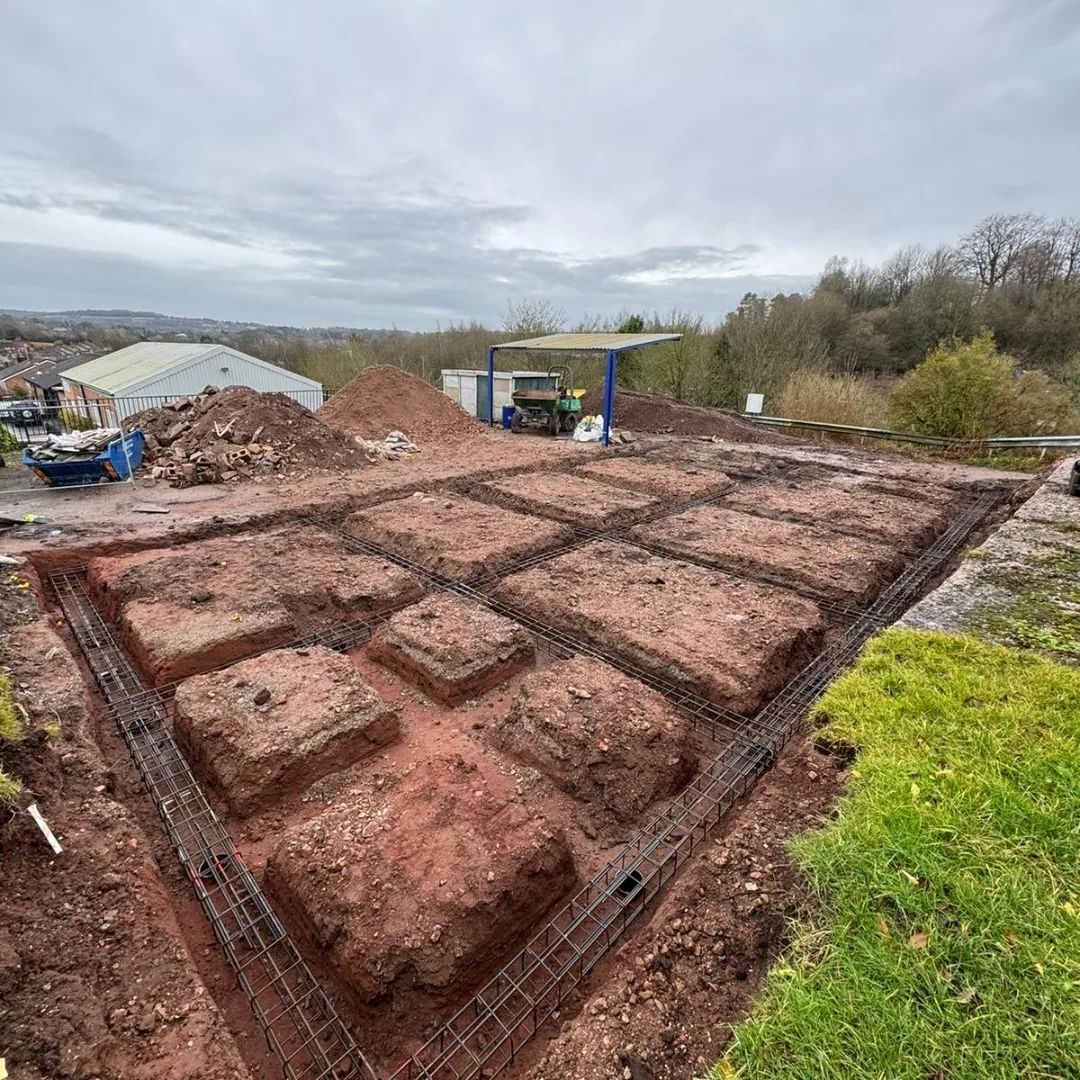
Strip foundations (or continuous footings) are long, narrow strips of concrete used to support load bearing walls. They are typically used in housing projects and smaller commercial buildings where loads are relatively uniform and soil conditions are consistent.
The width and depth of the strip depend on wall load and soil bearing capacity. This foundation type remains one of the most widely used methods in traditional UK construction due to its simplicity and reliability.
Choosing the Right Shallow Foundation
Selecting the correct type of shallow foundation requires more than just following standard practice. It depends on ground conditions, design loads, and site constraints. A detailed site investigation and geotechnical assessment should always be carried out before deciding on the foundation type.
At WL Piling, our engineers work closely with developers and structural designers to assess soil stability, calculate bearing pressures, and recommend the safest, most cost effective solution. We bring decades of expertise and local experience to every project, ensuring your structure stands firm for years to come.
Shallow vs Deep Foundations: When to Choose Each
The main difference between shallow and deep foundations lies in depth and load transfer mechanism. Shallow foundations are used where surface soils can safely bear structural loads. Deep foundations, such as piling, driven piling, or grundomat piling, are required when the surface soil is weak or unstable.
For example, in areas of soft clay or filled ground, piling provides greater stability and prevents settlement. However, where the soil is dense and load requirements moderate, shallow foundations remain the most economical option.
Building Strong Foundations for the Future
Understanding the types of shallow foundation helps ensure your project starts on the right footing. At WL Piling, we pride ourselves on offering expert foundation solutions across the North West and beyond. Our experience in both shallow and deep piling techniques ensures your structure is supported by the most reliable foundation possible.
To discuss your project or request a free consultation, contact our team today and let’s build something that lasts.